
Patient Sample
A blood sample provides access to circulating host-response information.
Our Lead iNOS Diagnostic
perSeptive Diagnostics is developing a quantitative blood test for vesicle-associated inducible nitric oxide synthase (iNOS). Our aim is to give clinicians an additional host-response signal to support earlier sepsis recognition alongside existing assessment and testing.
The Earlier Detection Opportunity
The lead program investigates whether vesicle-associated iNOS can provide useful information as sepsis develops. Clinical studies must establish when the signal becomes informative and what it adds to current assessment.
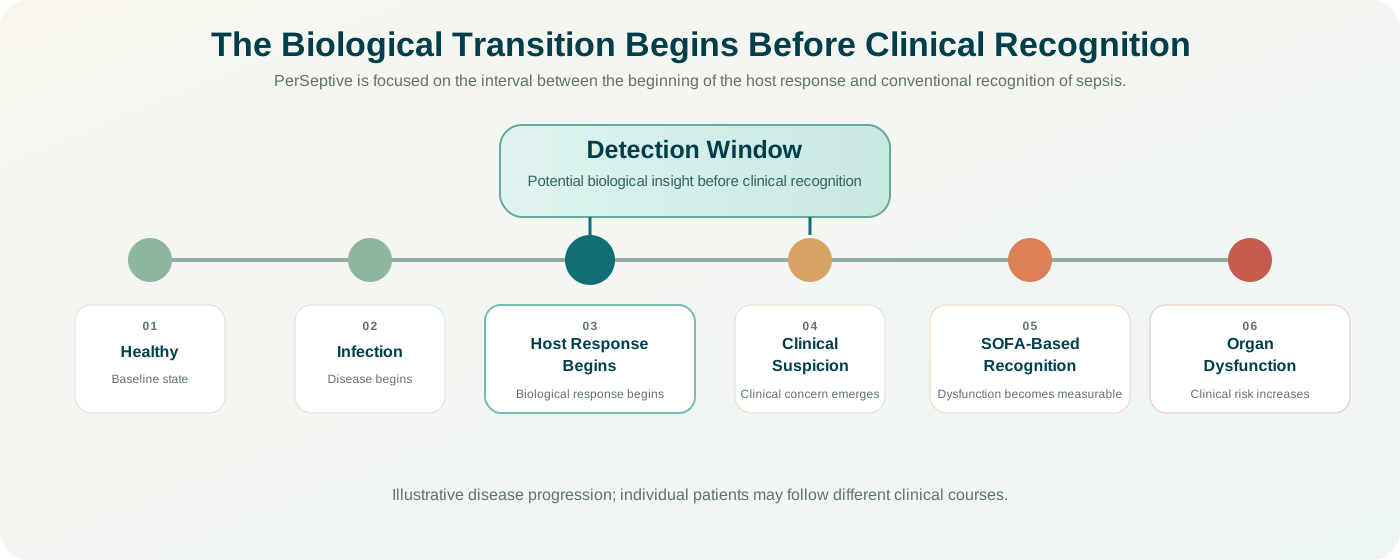
The timing graphic illustrates the development opportunity. It does not establish a validated detection window or a proven time advantage for the PerSeptive test.
The Proposed Assay Workflow
The diagnostic is being developed to prepare a blood sample, quantify the iNOS signal, and report a result for interpretation in clinical context. Assay performance, reporting, and turnaround time remain development priorities.
A blood sample provides access to circulating host-response information.
The sample is prepared to make the target biological signal available for measurement.
The assay is designed to quantify vesicle-associated iNOS, the lead candidate biomarker.
Measurement data would be reported as a quantitative result, with interpretation supported by clinical validation.
The iNOS result is intended to complement clinical assessment, other biomarkers, and pathogen testing in suspected sepsis.
Clinical Integration
Our iNOS diagnostic is being developed to add host-response information to the assessment of possible sepsis. This proposed workflow illustrates its intended place alongside existing tests, subject to clinical validation and applicable authorization.
History, symptoms, vital signs, and examination guide immediate assessment and the selection of appropriate tests.
Complementary information gathered in parallel, as clinically appropriate
Blood counts, lactate, organ-function tests, and biomarkers such as CRP or procalcitonin, where appropriate, contribute information about the patient's condition.
Clinical severity and inflammatory context
A proposed quantitative blood test for vesicle-associated iNOS, intended to add information that may support earlier sepsis recognition.
An additional candidate host-response signal
Cultures and, when indicated, PCR or sequencing help investigate the organism. Susceptibility testing and validated resistance markers inform antimicrobial selection.
Organism identification and treatment-relevant findings
Clinicians integrate available results with the patient's course to guide treatment, monitoring, and further investigation. Tests answer different questions and may return at different times.
Established-care context: Surviving Sepsis Campaign adult guidelines. The proposed PerSeptive workflow is a development concept and is not a guideline recommendation.
Platform Design
Investigate whether the iNOS signal can support earlier recognition of sepsis.
Designed to produce a measurable result rather than a qualitative impression.
Evaluate how the iNOS signal changes over time and whether repeat measurement adds clinical value.
Developed to support clinical judgment rather than replace established assessment.
Explore the Biology
Explore vesicle-associated iNOS biology and the distinction between extracellular vesicles, microvesicles, and exosomes.